Thinking about the supports that I have daily, I would consider myself fortunate and thankful. Basic supports such as good health and money, provide for my family and myself continuously. Taking a look deeper and acknowledging other supports not so evident to others, include my husband and children, my mother and father, friends, and co-workers. My mother and father have been extremely supportive in helping with our children since I began going back to school. It is as if their support is unspoken. They know seem to know when I need time for myself and volunteer to take the children for some time. My husband, extremely helpful but not as "unspoken" is always there to support our family and my educational needs whenever needed. Our children remind me of what it is to be innocent, playful, and free. They are the one's that help me to take a break from the hustle and bustle and relax and enjoy every day. Friends and co-workers are there, not as frequently as family, but whenever I need them. I could not imagine my life without any one of these supports. Together they provide a balance for me.
Because everyone has challenges that come at different times and in many styles, severities, forms, I believe that supports are essential during challenging times. Supports also come to us in different forms, whether it be monetary support, relationship support, health support, friendship support, etc. Just as children have indivdual needs at different times, adults also have these individual needs and supports at different times.
Sunday, February 12, 2012


Saturday, January 28, 2012
My Connections to Play
"Creative play is like a spring that bubbles up from deep within a child." ~Joan Almon
"Children need the freedom and time to play. Play is not a luxury. Play is a necessity." ~Kay Redfield Jamison
Looking back on my childhood, I believe people supported my play by allowing me to be a child, explore my environment, hours of unstructured time, the great outdoors, and cousins and neighborhood friends. Time was spent outdoors, with a ball, bike, and outdoor pets. Wow, thinking back, I didn't have much in the way of "toys". However, the little I did have allowed for creativity, freedom, learning how to care for pets and eventually others, problem-solving, games with rules, negotiation, and conflict-resolution. Many of these skills have carried through to adulthood. These were the times where x's were made in stones for bases, rocks were used to make marks on the road for start and finish lines, and safety was experienced through play. Considering my age, it was not that long ago that this type of play was able to occur.

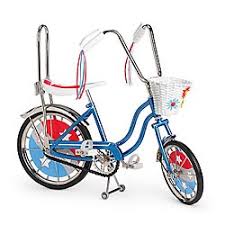
Kickball Bicycle with basket and banana seat
Has this type of play nearly disappeared? From research and my observations, it is seeming so. Todays parents are concerned about safety, find it easier to keep track of children while indoors, do not have open areas, parks, or yards to let their children play in, or are tied up with work, school, etc. to take the time to travel to parks. The electronic age has taken over! It is my hope that we will look back to previous generations and understand and value all they had to offer. To this day, I make sure my own children have that unstructured time outside with each other and neighborhood friends. They also are provided with balls, bikes, pogo sticks, trees, and many other open-ended toys. Do they have electronics, of course, but like anything, their is a time and place for those items.
As I reflect back on my childhood, I am proud that I was given such opportunities to play. I also remember kindergarten as a time for arts and crafts, playing, making friends, and cookies and milk. I don't even remember doing many worksheets or even "learning", so play must have been a priority back then. Can we go back to those good old days? I hope sooner than later.
"Children need the freedom and time to play. Play is not a luxury. Play is a necessity." ~Kay Redfield Jamison
Looking back on my childhood, I believe people supported my play by allowing me to be a child, explore my environment, hours of unstructured time, the great outdoors, and cousins and neighborhood friends. Time was spent outdoors, with a ball, bike, and outdoor pets. Wow, thinking back, I didn't have much in the way of "toys". However, the little I did have allowed for creativity, freedom, learning how to care for pets and eventually others, problem-solving, games with rules, negotiation, and conflict-resolution. Many of these skills have carried through to adulthood. These were the times where x's were made in stones for bases, rocks were used to make marks on the road for start and finish lines, and safety was experienced through play. Considering my age, it was not that long ago that this type of play was able to occur.
Kickball Bicycle with basket and banana seat
Has this type of play nearly disappeared? From research and my observations, it is seeming so. Todays parents are concerned about safety, find it easier to keep track of children while indoors, do not have open areas, parks, or yards to let their children play in, or are tied up with work, school, etc. to take the time to travel to parks. The electronic age has taken over! It is my hope that we will look back to previous generations and understand and value all they had to offer. To this day, I make sure my own children have that unstructured time outside with each other and neighborhood friends. They also are provided with balls, bikes, pogo sticks, trees, and many other open-ended toys. Do they have electronics, of course, but like anything, their is a time and place for those items.
As I reflect back on my childhood, I am proud that I was given such opportunities to play. I also remember kindergarten as a time for arts and crafts, playing, making friends, and cookies and milk. I don't even remember doing many worksheets or even "learning", so play must have been a priority back then. Can we go back to those good old days? I hope sooner than later.
Saturday, January 14, 2012
Relationship Reflection
As I reflect on relationships that were meaningful in my life, there are three that stand out the most: my family, my closest friends, and my co-workers. Each have similar and different qualities about them that help keep our relationships positive and healthy.
When thinking of my family relationships, I think of my husband. He is the man that sticks by me through thick and thin. I met my husband when going to college (for the first time). Our relationship grew immediately. We enjoyed similar activities, had similar friends, and had the same views about raising a family. We had differences as well, which is where other relationships in my life come into play! Some of these include our professions and SPORTS! Compromising, openness, and a sense of humor are characteristics of our relationship that have kept us happily together.
Some of my closest friends, before meeting my husband and today, are yet another positive piece to healthy relationships in my life. Friend relationships are give and take, talk and listen, and laugh and cry. They are the ones that are their when a break from everything is needed and deserved. Never judgmental and always available. Although we all have families and are quite busy, we never forget to find time for each other and schedule "girl days/nights out".
Lastly, my co-workers... They share the same profession and have similiar professional goals. We are there to remind each other to remain open minded, continue to become life long learners, be conscience of our biases and to not forget what we have gone to college for...children and their families. And although it is at times hard to do all of these things, they are the ones to listen and share powerful words to remind me that life is a challenge, but together we are able to reach our dreams. Dreams in our profession, dreams for our family, and dreams for ourselves.
These personal relationship experiences are similar experiences involved with working with children and their families. It is important to be open minded, compromise, aware of biases and be able to put them aside, and both listen and know when to share information.
When thinking of my family relationships, I think of my husband. He is the man that sticks by me through thick and thin. I met my husband when going to college (for the first time). Our relationship grew immediately. We enjoyed similar activities, had similar friends, and had the same views about raising a family. We had differences as well, which is where other relationships in my life come into play! Some of these include our professions and SPORTS! Compromising, openness, and a sense of humor are characteristics of our relationship that have kept us happily together.
Some of my closest friends, before meeting my husband and today, are yet another positive piece to healthy relationships in my life. Friend relationships are give and take, talk and listen, and laugh and cry. They are the ones that are their when a break from everything is needed and deserved. Never judgmental and always available. Although we all have families and are quite busy, we never forget to find time for each other and schedule "girl days/nights out".
Lastly, my co-workers... They share the same profession and have similiar professional goals. We are there to remind each other to remain open minded, continue to become life long learners, be conscience of our biases and to not forget what we have gone to college for...children and their families. And although it is at times hard to do all of these things, they are the ones to listen and share powerful words to remind me that life is a challenge, but together we are able to reach our dreams. Dreams in our profession, dreams for our family, and dreams for ourselves.
These personal relationship experiences are similar experiences involved with working with children and their families. It is important to be open minded, compromise, aware of biases and be able to put them aside, and both listen and know when to share information.
Monday, December 19, 2011
Quotes about Child Development
If kids come to educators and teachers from strong, healthy functioning families, it makes our job easier. If they do not come to us from strong, healthy, functioning families, it makes our job more important. Barbara Colorose
A baby is born with a need to be loved - and never outgrows it. Frank Howard Clark
It is with children that we have the best chance of studying the development of logical knowledge, mathematical knowledge, physical knowledge, and so forth. Jean Piaget
It is with children that we have the best chance of studying the development of logical knowledge, mathematical knowledge, physical knowledge, and so forth. Jean Piaget
Saturday, December 10, 2011
School-Age Assessment
School-age assessments and testing is a controversal topic. I believe that testing, assessments, and benchmarks are a framework for what children should be obtaining from their school. It also helps to hold teachers accountable. However, I believe test scores should not be the only source of academic and social competency. A more holistic approach, including academics, social, developmental, and cultural aspects should be considered. Schools should assess children in the beginning of the school year, adjust their teaching to meet individual needs and continue in this manner.
The Danish school system traditionally had no formal assessments. Assessment was informal, formative by nature, and directed towards students and parents. They valued inclusion, partricipation, and dialogue between teacher and student, and a sense of community. Students were motivated and confident in academic ability. However, as the world is becoming more complex, standardized testing is making its way into the Danish school system (Dolin & Krough). The PISA (Programme for International Student Assessment) takes into account literacy skills, sets benchmarks for educational improvement, and notes strengths and weaknesses of the educational system. This assessment has noted that Danish children are the most motivated to learn, however academically fall below the norm. Even though PISA makes changes to traditional priorites in the Danish setting, formal assessment has made its way into the school system.
Dolin, J., Krough, L.B. (2010), The Relevance and Consequences of PISA Science in a Danish Context. International Journal of Science and Math Education.
The Danish school system traditionally had no formal assessments. Assessment was informal, formative by nature, and directed towards students and parents. They valued inclusion, partricipation, and dialogue between teacher and student, and a sense of community. Students were motivated and confident in academic ability. However, as the world is becoming more complex, standardized testing is making its way into the Danish school system (Dolin & Krough). The PISA (Programme for International Student Assessment) takes into account literacy skills, sets benchmarks for educational improvement, and notes strengths and weaknesses of the educational system. This assessment has noted that Danish children are the most motivated to learn, however academically fall below the norm. Even though PISA makes changes to traditional priorites in the Danish setting, formal assessment has made its way into the school system.
Dolin, J., Krough, L.B. (2010), The Relevance and Consequences of PISA Science in a Danish Context. International Journal of Science and Math Education.
Saturday, November 26, 2011
How poverty affects children's development
Working for a Head Start program, I see daily how poverty can be a stresser in a child's life. President Johnson talks about poverty being like a family birthmark that is passed down from generations (Johnson, 1965). With poverty can come unsuitable housing, lack of nutritious meals, lack of medical attention, and minimal educational support. These stressors can cause caregivers to abuse and neglect their children, which will have negative effects on a young child's development. Biosocially children may not grow properly or may not thrive if proper nutrition is not available. Lack of medical attention also negatively impacts a child's biosocial development. Language development may be delayed if parent do not see the benefits of quality interactions with their children in their youngest years. Early childhood is a prime learning period (Berger, 2009). Programs, such as Head Start, help parents to understand the importance of quality interactions, medical attention, proper housing, and nutrition and exercise.
I chose to research how poverty affects Haiti and how natural disasters, like hurricanes, are a direct result of poverty, in the poorest nation in the western hemisphere. With oil too expensive for this poverish country, the people have resorted to using charcoal from burnt trees for energy (Masters, 2011). Large amount of cut trees have left empty mountain slopes that allows rainwater to wash down unimpeded. In 1980, Haiti had 25% of its forest remaining and the country was able to withstand a category 3 hurricane with no lives taken. However, only 1.4% of the forest remain and only heavy rains from a tropical storm are enough to take thousands of lives (Masters, 2011). Children are affected as their families are torn apart from death and disaster. Education and poverty eradication are necessary for improvement. Reforestation efforts and promoting of alternative fuels is necessary.
Berger, K.S. (2009). The Developing Person (5th edition). New York, NY: Worth Publishers.
Johnson, L. (1965, May 18). [Project Head Start speech]. Speech presented at the White House, Washington D.C.
Masters, J. (2011). Hurricanes and Haiti: A Tragic History. Retrieved from: http://wunderground.com/
I chose to research how poverty affects Haiti and how natural disasters, like hurricanes, are a direct result of poverty, in the poorest nation in the western hemisphere. With oil too expensive for this poverish country, the people have resorted to using charcoal from burnt trees for energy (Masters, 2011). Large amount of cut trees have left empty mountain slopes that allows rainwater to wash down unimpeded. In 1980, Haiti had 25% of its forest remaining and the country was able to withstand a category 3 hurricane with no lives taken. However, only 1.4% of the forest remain and only heavy rains from a tropical storm are enough to take thousands of lives (Masters, 2011). Children are affected as their families are torn apart from death and disaster. Education and poverty eradication are necessary for improvement. Reforestation efforts and promoting of alternative fuels is necessary.
Berger, K.S. (2009). The Developing Person (5th edition). New York, NY: Worth Publishers.
Johnson, L. (1965, May 18). [Project Head Start speech]. Speech presented at the White House, Washington D.C.
Masters, J. (2011). Hurricanes and Haiti: A Tragic History. Retrieved from: http://wunderground.com/
Friday, November 11, 2011
Mental Health of mothers, fathers, and families
Mental health of mothers, fathers, and families, is key to a healthy development of young children. These members are the child's immediate environment, and the more stable families are, the better chance a child will have a more positive mental health. This is meaningful to me in my current position of working with children of poverty and their families. I assist families in receiving the proper interventions so they can provide for their children. For young children, mental health of mothers can affect a secure mother-infant attachment. A fathers involvement with the mother and family can either strengthen or deprive the child of a healthy development. If a father also has a mental health disability or is the cause of the mother's negative mental health, this can negatively impact the positive interactions. These conditions have been found to encourage behavioral and psychological problems in the child (Alvarez, Hosman, Walraven, Doesum, & Hoefanagels, 2010).
In developing countries, 12% to 15% of urban adults suffer from depression (Montgomery, 2009). Mental health of the mother can affect the ability to deploy in seeking healthcare for her children and other family members. This can become a vicious cyle. Mental health interventions are only beginning to be studied in developing countries (Montgomery, 2009).
"Happier husbands tend to be more involved fathers" (Berger, 2009). With this statement, I see in my future work, strongly encouraging fathers to get involved with their children and families. If parents can work together to solve problems and provide effectively for their families, children will reap the benefits.
Montgomery, M.R., June 2009. Urban Poverty & Health in Developing Countries. 64(2). Retrieved from http://www.prb.org/
Alvarez, L.E., Hosman, C.M., Walraven, J., van Doesum, K., & Hoefnagels, C. (2010), Long-term effects of a home-visiting intervention for depressed mothers and their infants. The journal of Child Psychology and Psychiatry. 51(10).
Berger, K.S., 2009. The Developing Person (5th Edition). New York, NY. Worth Publishing.
In developing countries, 12% to 15% of urban adults suffer from depression (Montgomery, 2009). Mental health of the mother can affect the ability to deploy in seeking healthcare for her children and other family members. This can become a vicious cyle. Mental health interventions are only beginning to be studied in developing countries (Montgomery, 2009).
"Happier husbands tend to be more involved fathers" (Berger, 2009). With this statement, I see in my future work, strongly encouraging fathers to get involved with their children and families. If parents can work together to solve problems and provide effectively for their families, children will reap the benefits.
Montgomery, M.R., June 2009. Urban Poverty & Health in Developing Countries. 64(2). Retrieved from http://www.prb.org/
Alvarez, L.E., Hosman, C.M., Walraven, J., van Doesum, K., & Hoefnagels, C. (2010), Long-term effects of a home-visiting intervention for depressed mothers and their infants. The journal of Child Psychology and Psychiatry. 51(10).
Berger, K.S., 2009. The Developing Person (5th Edition). New York, NY. Worth Publishing.
Subscribe to:
Posts (Atom)